Friday, January 9, 2009

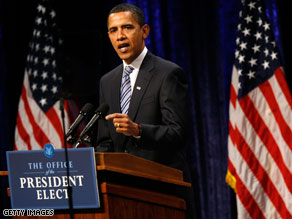
Obama's dire warning


American President-elect Barack Obama issued a dire warning, stating that Congress must take "dramatic action" in order to save the American economy. He warned America that if Congress does not step in, "the recession could for years. The unemployment rate could reach double digits." The unemployment rate, currently at around 7%, is already, numberwise, reached the highest number of unemployed since the Great Depression. "For every day we wait or point fingers or drag our feet, more Americans will lose their jobs. More families will lose their savings. More dreams will be deferred and denied. And our nation will sink deeper into a crisis that, at some point, we may not be able to reverse," he said. Obama claimed his plan could ignite the economy within three years, through a variety of methods. He said the cost would be "considerable" and it would "certainly add to the budget deficit in the short term." Outside analysts have guessed a price tag of around $800 billion. However, when compared to the failed bailouts given by Congress in 2008, Obama replied that they "won't just throw money at our problems - we'll invest in what works." The earliest his stimulus package could be passed and signed into law would be mid-February.

If you heard Obama's speech, you would know how bad he thinks the crisis is. Maybe there are figures that the government has withhold from the rest of the world, but I think that the economy is much worse than everyone thinks. On his campaign trail, Obama was always positive, looking to bring change into America, telling people to not worry, to know that help was coming. However, the economy is still not getting better. A few days ago the Dow fell 205, its most since December 1st. Many people are criticizing Obama for his massive plan which could cost at least 1 trillion dollars. However, there are just as many people asking for more than a 1 trillion dollar bailout. I think world governments should start creating jobs like Roosevelt did during the Great Depression. Roosevelt's New Deal began in the early '30s and by the time the Second World War began, the economy was well on its way to recovery. I think Obama's 3 million job promise is similar to Roosevelt's New Deal. Let's hope it works as well as it did back in the 1930s so our generation do not need to suffer a generation of poverty as did the children of the Great Depression.

http://www.cnn.com/2009/POLITICS/01/08/transition.wrap/index.html

Thursday, January 8, 2009

Israelis hit UN convoys


The UN has suspended its humanitarian efforts to help the residents of Gaza after an UN truck driver was killed by an Israeli tank shell. Israeli forces apparently fired upon a UN convoy during a three-hour truce to deliver humanitarian aid to civilians. Quoting from CNN, "The U.N. 'lost confidence' in the Israeli military's attempts to allow humanitarian aid into the Palestinian territory." An UN official, John Ging, said that the Israeli military had cleared the convoy into Gaza. He expressed frustration, stating that "it is unacceptable that their soldiers are firing at us on the ground." This is not the only time that the Israeli military injured UN workers. Four UN aid workers have been killed since the air strikes began on Dec. 27. Two UN schools have also been hit.

I am not sure if this attack was by or something else. The fact that so many s were caused by the Israeli Defense Force is an unsettling fact that should be taken into further account. Even though the Israelis consider this conflict as war, they still should take consideration into the hardships of the civilians living in the Gaza Strip. They are now going through worse conditions than Israeli civilians being hit by Hamas rockets. Civilization has become less barbaric. When an international task force delivers food, water, and other supplies, they should be given full protection from both sides of a conflict. If this attack was on purpose or as a joke from an Israeli serviceman, well, shame on you, Israel.

http://www.cnn.com/2009/WORLD/meast/01/08/israel.gaza/index.html?iref=mpstoryview

Tuesday, January 6, 2009

"I will end up with a bank"


Wilbur Ross, known for his investments in troubled companies in the steel and automotive industries, stated his firm would eventually end up with a bank before the recession ends. "We will end up with a bank, there is no doubt," said Ross. He is a major figure in the private equity industry, and had planned to purchase a bank last year. However, this plan delayed after the government pumped capital into America's banks as a part of a plan to halt the recession. He estimated that this move delayed his investment into a commercial bank or thrift institution from six to twelve months. Ross has already made his moves in this recession, buying H&R Block's sub-prime mortgage servicing unit for $1.3 billion and acquired the bankrupt American Home Mortgage Investment Corp. However, some of these investments are bad investments, such as buying the bond insurer Assured Guaranty's stock for $23 a share. It has now fell about 50% since February, the time he bought it.
Buying a bank is not a bad investment. Other private equity investors are also looking for banks to purchase. Ross explains, "What is important is to get access to a stable, low-cost source of funding. That is what we are interested in." Another positive note for Ross and his fellow investors is that banking regulators have relaxed restrictions for potential buyers in hopes of convincing outside investors to bid for the banks.
As all investments are, buying banks still have high risks. The private equity firm TPG invested in Washington Mutual last year, a bank which collapsed in September, becoming the largest bank failure in history. It was then sold to JP Morgan Chase.
Ross argues that it makes more sense if private equity firms are allowed to take full ownership of the bank they purchase instead of just a small stake.
"Private equity is not passive. We are not minority investors. We are control investors. That is the whole theory of private equity - adding value through better management," he said.


Many rich investors are either pouring money or about to pour money into the markets. With prices for many industries, such as the real estate and stock market, falling steeply, almost any investment makes a good investment. When the recession is over, most of these prices will rise again. I think investing now is a great idea as things have already went past the rock bottom. The bottom has already passed when the Dow went below 8,000. I don't think it will ever go that low again, unless one of the Big Three fails, which is unlikely to happen. If a person does not start investing now, they will miss a chance to make great amounts of money.

http://money.cnn.com/2009/01/06/news/companies/ross_banks/index.htm

Saturday, January 3, 2009

At least 4 Palestinians killed in ground assault


After a week-long air strike against set targets, the Israeli military sent its ground troops into the Gaza area. Thousands of soldiers moved into Gaza, resulting in the s of at least 4 Palestinians. This move is strongly opposed by many groups and nations, including the United Nations. However, Israel justified its actions by declaring that it is an offensive to halt the missiles hitting Israeli soil on an almost daily basis. Israel hopes to force the Hamas to stop their attacks on Israel by invading their territory, but it has not worked. The Hamas leadership promises to "fight until the last breath" and that "Gaza is your cemetery." Their leadership is determined to continue to resist these Israeli counteroffensives towards Palestinian civilians, and also stated to "fight in the every house, every street, every building."
The other side of this conflict is the humanitarian issue, which was made worse by this offensive. Many UN observers plead with Israel to stop this offensive, as conditions for civilians were bad even before the offensive. The territory needed electricity, food, and water before it began. Now, many fear that electricity would be cut once again, as in previous armed conflicts. In some places, it has already been lost. Others worry that if the conflict prolongs, civilians might die from starvation or thirst. This conflict could affect the Palestinian civilians in many different ways.

In the eye of the Israelis, this is a defensive move, designed to stop attacks on their civilians by overrunning the places where missiles could be launched at Israel. However, the Hamas view this as a move to attempt to conquer the Muslims in the area. I think this conflict needs to be resolved quickly to avoid bloodshed on both Israeli and Palestinian sides. Every missile barrage the Hamas military fires results in a retaliatory bombing that leave more Palestinians than Israelis dead. It also leaves behind a thirst for revenge. An obvious solution I can see is for the Hamas to stop firing missiles; this definitely would cease attacks by the Israelis. However, they must have their own reasons for their rocket attacks. I am not sure which, but I am guessing that they need to show the extremists in their land that things are being done. I think they definitely should stop attacking Israel, because more Palestianian civilians than Israeli civilians are dying because of the rockets. If they can both come to a truce, then there is hope for an Israeli-Palestinian union.

http://www.cnn.com/2009/WORLD/meast/01/03/israel.gaza/index.html